Babies move through a lot of exciting milestones fast, but few are as thrilling as watching your child learn to talk. Newborn language development unfolds gradually over the first several years, moving from crying and babbling to individual words and eventually full sentences.
You’re probably counting down the days until you can have an actual conversation with your little one, and that day will come, just maybe not as fast as you’d like. Here’s a general guide to when should my baby say their first words, what to expect at each age, and when it’s worth checking in with your child’s provider.
Typical Speech Milestone Timelines
Children don’t develop on a fixed schedule, but most tend to reach certain milestones around the same age as their peers. If your child is doing most or all the following by the age listed, they’re progressing right on track.
Birth to 3 Months
At first, your baby communicates mainly through crying, whether they’re hungry, need a diaper change, or just want attention. Within the first few months, they’ll also start to:
- React to or startle at loud sounds
- Calm down when spoken to or smiled at
- Smile when they see you and recognize familiar voices and faces
- Make cooing sounds when happy
- Cry in different ways for different needs
4 to 6 Months
- Follows sounds with their eyes and responds to changes in tone of voice
- Pays attention to music or toys that make sounds
- Starts babbling with p, b, or m sounds
- Starts laughing and making vowel or gurgling sounds
7 to 12 Months: When Do Infants Start Talking?
This is an exciting stretch when your child starts making purposeful sounds and may say their first word. Along the way, they’ll also:
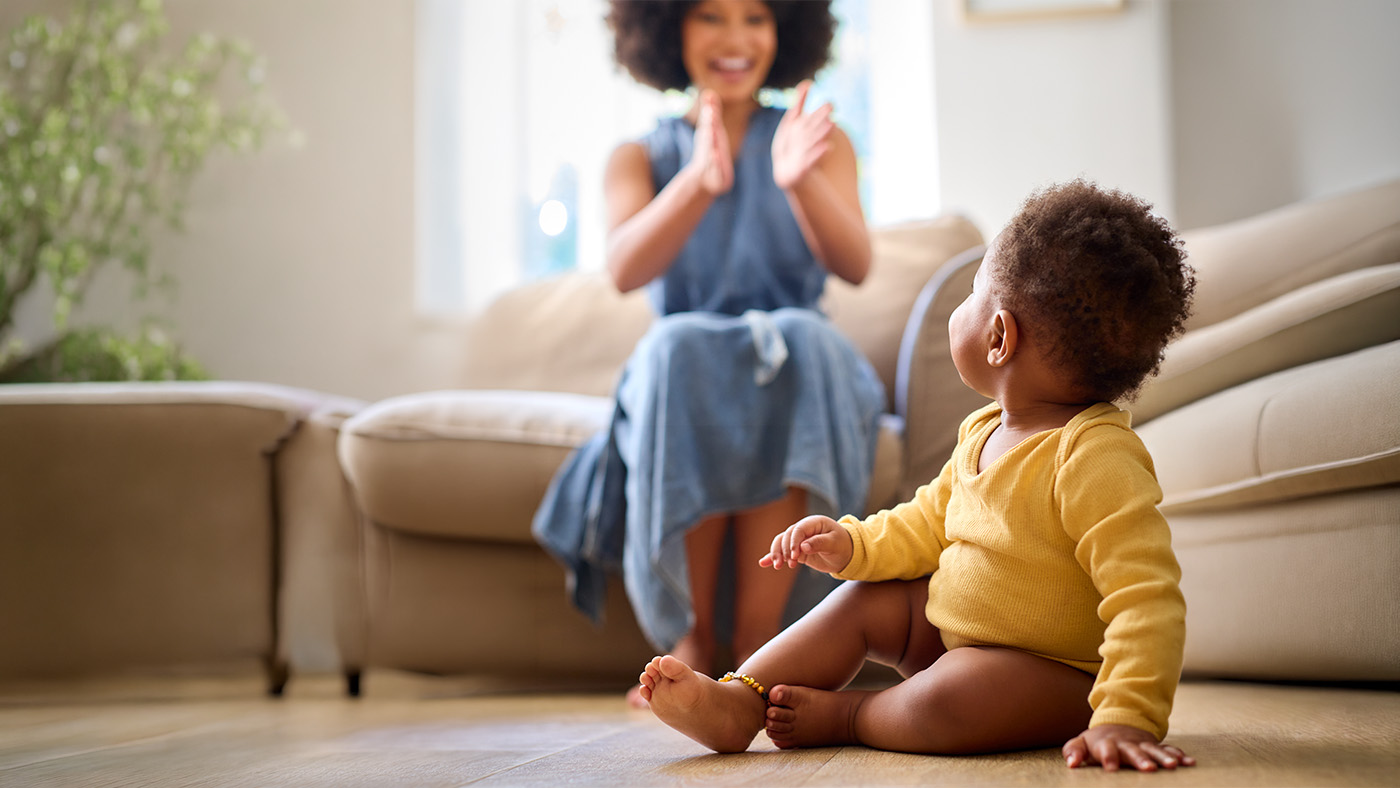
- Enjoy games like pat-a-cake and peekaboo
- Turn and look toward sounds or speech, and begin understanding words like cup, toy, or food
- Respond to simple requests like “come here” (even if not exactly the way you’d hoped)
- Use sound combinations like “bibi” or “tata” to get your attention
- Use gestures like waving, and attempt to imitate words and speech sounds
Remember that language development includes both understanding words (receptive language) and speaking words (expressive language). In many children, understanding develops well before spoken language
12 to 18 Months: How Many Words Should a 12-Month-Old Say?
Most 12-month-olds are just getting started with words, often just one or two, like “mama” or “hi.” Over the next several months, your baby’s vocabulary expands quickly. They may pick up as many as 50 words and start experimenting with simple phrases.
- Points to a few named body parts when asked
- Follows one-step directions like “roll the ball”
- Responds to simple questions like “who’s that?”
- Listens attentively to stories and points to pictures when you name them
18 to 24 Months: How Many Words Should an 18-Month-Old Say?
By 18 months, many toddlers say around 10 to 20 words, and that number climbs quickly from there.
- Uses lots of new words and experiments with p, b, m, h, and w sounds
- Starts naming pictures in books, not just pointing to them
- Says simple phrases and questions like “what’s that?”
- Puts two words together, like “no bed” or “more snack”, and can say more than 50 words by age 2
2 to 3 Years: How Many Words Should a 2-Year-Old Be Saying?
By now, most children have a vocabulary of 200 to 1,000 words on average. This is also when they tend to:
- Show early signs of understanding grammar
- String words into three or four-word sentences
- Be understood by family and others who spend regular time with them
- Understand opposites (go and stop, up and down) and location words (in, on, under)
- Follow two-part directions like “get the toy and put it away”
Language Milestones for a 3-Year-Old
- Hears and understands you when you’re in another room
- Answers simple who, what, where, and why questions
- Talks about their day, including things that happened at preschool or daycare
- Constructs sentences with four or more words and speaks mostly understandably
- Understands and follows multi-step directions
Language Milestones for a 4-Year-Old
- Pays attention to a short story and answers questions about it
- Hears and understands most of what is said to them throughout the day
- Includes details in their sentences and tells stories related to a topic
- Speaks clearly enough for strangers to understand, aside from a few tricky sounds
- Recognizes some letters and sounds, building early pre-reading skills
How to Encourage Speech Development at Home
One of the best things you can do for your child’s language development is simply talk with them, often and naturally, throughout the day.
- Look at your baby when they make sounds and talk back to them like you’re having a real conversation.
- Narrate your day: talk while feeding, bathing, or changing them, and describe what you’re doing and what’s coming next.
- Point out objects, colors, and shapes as you move through the world together.
- Read developmentally appropriate books and play clapping games like pat-a-cake.
- If you use baby talk, that’s completely normal, just be sure to also model grown-up words alongside it, like, “Where’s the baba? Where’s your bottle?”
- Let your child make choices between toys, snacks, or clothing items, and praise them when they communicate.
- If you’re not sure what they’re trying to say, repeat it back to check, and build on their words: if they say “ball,” try, “Yes, it’s a big, red ball.”
Those little conversations throughout the day add up and expose children to thousands of words in a natural way without requiring extra time or special activities.
When to Be Concerned About Speech Development
Milestones commonly happen around a certain age, but every child is a little different, and some hit milestones earlier or later than their peers. If your child is under 3 and developing normally in every other way, they may simply be a late talker.
That said, a few patterns are worth flagging to your child’s provider:
- Not babbling or gesturing by 12 months
- Not responding to their name by 15 months
- Not using any words by 18 months
- Not responding to questions or directions
- Communicating mostly through crying or yelling by 24 months
- Not using two-word phrases by 30 months
If you notice any of these patterns, reach out to your child’s provider. It may turn out to be nothing, but it’s always worth a conversation, and early support makes a real difference when there is a delay.
A Note from Our Team
Every child finds their own pace with language, and it’s normal to have questions along the way. If you’re noticing any of the patterns above, or you just want a second opinion, contact your provider at Families First Pediatrics. We’re glad to help you figure out what’s typical for your child.
Sources:
AAPD, Speech and Language Milestones
Yale, Understanding language development milestones
Mayo Clinic, Language development: Speech milestones for babies
Stanford Medicine, Age-Appropriate Hearing, Speech and Language Milestones
CDC, CDC’s Developmental Milestones
Communication Health Support Association, Tips For Your Child’s Speech and Language Development
Raising Children Network, Language and play: babies
University of Utah, Child Not Talking Yet? When to Worry About a Speech Delay
Communication Health Support Association, Late Talker or Language Problem